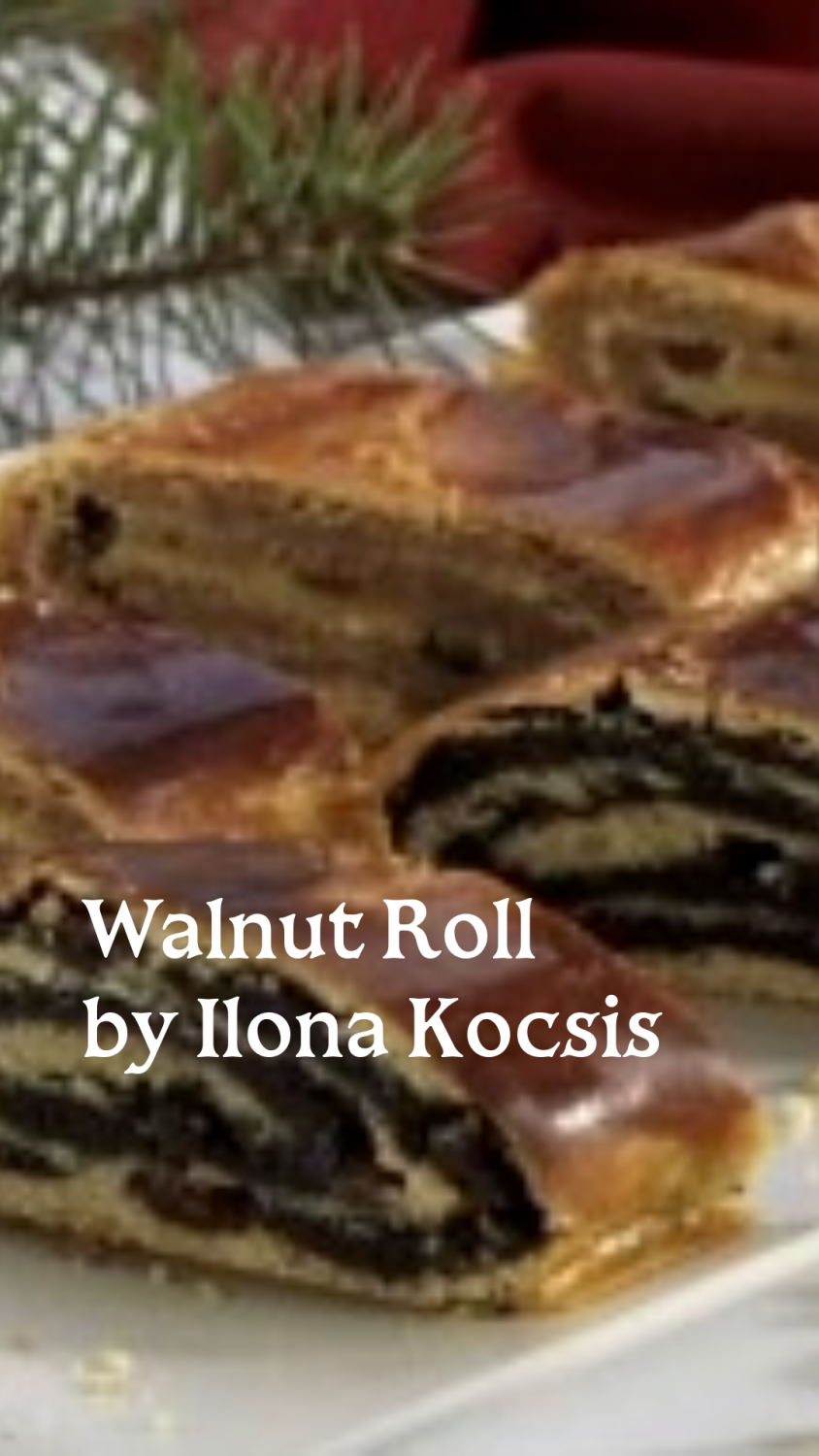
By Ilona Kocsis.
Rozália flits around the kitchen with restless uncertainty, like a sparrow that can’t decide where to land. She needs a distraction to dull her constant feelings of displacement. She has an old Hungarian cookbook, the only possession she has kept from her homeland. It bears the weight of loss, an inherited sorrow, heavy in her hands before a word is even read. Rozália gently opens the cookbook, turning to the walnut roll recipe. A bag of walnuts lies unopened on the orange laminate benchtop. A winter mood shrouds the kitchen; its lack of colour is muted like sunlight behind heavy curtains. The rain-filled sky outside shows a cold winter’s day in Melbourne, 1971.
Helen, Rozália’s young daughter, skips in from playing outside in the puddles left by the recent downpour, sliding into the kitchen, her face beaming and flushed red from the cold. Her long, thick blonde hair is plastered to her face. Her grey eyes shine like pebbles washed clean by a river current.
‘Helen,’ cries out Rozália, ‘vat are you doing, dripping muddy vater all over kitchen floor?’
Helen’s rosy cheeks sag, and her happy mood slips away like air from a balloon. Rozália ignores her daughter’s dejected expression.
‘Take off muddy boots, leave them dry in laundry. You said you vant help make valnut roll. Here, put on apron, I tie hair back, vash hands.’
Helen’s excitement swells like bread dough in a warm bowl.
‘Mummy? I love walnut roll. Can I grind the walnuts for you, Mummy?’
Rozália doesn’t answer her daughter’s question. She knows Helen loves her cookbook, but she forbids her to touch it. The book was a gift from Rozália’s father before he died. Rozália carefully studies the recipe. Beside the cookbook is a notepad titled Translated Recipes. She turns to a blank page and painstakingly begins to translate the list of ingredients for the walnut roll from Hungarian into English, vigorously scratching away misspelled words. Walnuts, flour, yeast, apricot jam, sultanas, butter, eggs, sugar, salt, milk, sour cream, vanilla essence, lemon rind and rum.
‘Helen, get valnut grinder from cupboard.’
The manual grinder is bright orange with a clear glass container to catch the walnut grounds. Helen places it next to the unopened walnut packet.
‘Can I help now, mummy. Pleease?’
‘Okay, I’m varning you. Don’t make mess. One spoon, then turn handle, grind.’
‘Yippee, mummy! I’ll be careful.’
Spooning small amounts, Helen turns the handle as the walnuts grind and drop down like breadcrumbs into the glass compartment. The smell of freshly ground walnuts moves through the kitchen with a delicious aroma. As the nuts are crushed, their natural oils release a fragrance that is earthy yet sweet, like the familiar musty smell of an old apartment in Budapest. Rozália breathes in the memory as she busies herself with the dough.
Rozália reluctantly allows Helen to work the grinder with her tiny hands. Sensing a mishap, like the faint crack before glass breaks, Rozália turns to see Helen knocking the grinder over, spilling some of the ground walnuts onto the kitchen benchtop. She watches as Helen clumsily brushes the walnut grounds into a pile and fills an empty bowl with her mistake. The walnut grinder lies exposed in a compromised position. Quietly fuming, Rozália takes the messy parts to the sink for washing. Instead, she bends down, dropping each part into the bin under the sink.
‘No, mummy. What are you doing? Please don’t throw it away. I won’t make a mess again.’
‘You always make mess. That’s vhy I vish you not help me in first place. I finish making valnut roll, not you.’ She slams the cookbook shut.
‘Mummy, I’m sorry, no, no,’ sobs Helen haltingly.
Rozália doesn’t recognise her daughter. She sees her as though she is a memory wearing her sister’s face. She decides to overwrite these false images by refusing to open the cookbook’s pages, leaving recipes unread.
Later, Rozália, her voice flat, the edges of emotion filed away, says to her husband and daughter, ‘I put in bin. Hungarian cookbook, is gone. No more valnut roll or gulyás or anyting Magyar. Now on, just Australian food for family.’
Helen’s mum, now in her mid-seventies, travels with her daughter to Hungary. Helen rents an apartment near the Hungarian State Opera House. Like most apartments in Budapest’s District VII, this one is recently renovated. It holds the scent of history mixed with fresh wallpaper and new furnishings. Helen breathes in a sense of belonging, like inhaling home itself. The façade of the Parisian-style apartment is caked in a rich vanilla buttercream colour. The edges of the walls and window frames are fashioned as though carved by the blade of an antique silver butter knife. The internal courtyard, typical of most Austro-Hungarian architecture, is dense and gloomy as natural light is locked away for most of the day. The steps down to the foyer are smooth and indented from the many footsteps taken before. The inky, dark staircase is almost pitch-black. Outside, it is a beautiful spring day in April. The trees are draped with pink candy blossoms. Helen delights in viewing Budapest through the lens of rose-coloured light.
Together, Helen and her mum step into the nearby Jewish Quarter, exploring it on foot. They are immediately struck by the spicy fragrance of Hungarian food that fills the air, making their mouths water. Bright red and green paprika peppers decorate shopfronts. Lecsó sits steaming in two bowls on an outside dining table, ready to be enjoyed. There are murals on buildings, painted by local Hungarian artists. They pass one with a phrase that says Mindenkinek van egy Városa.
‘Mum, look at the mural. I wonder what the words mean.’ She types it into Google Translate. ‘Everyone has a City. I love this! I reckon Budapest is my city.’
‘Helen, what? Why do you say Budapest is your city? Surely, Melbourne is your city? You weren’t even born here. You are Australian.’
‘My soul screams for my Hungarian heritage. I feel such a strong connection to this city. It feels like I’ve come home,’ says Helen.
‘That’s so stupid, you can’t even speak the language.’
‘You know I’m learning as best I can. Hungarian isn’t an easy language.’
‘It’s far too late for you to learn it now.’
‘I wish you had taught me when I was a kid.
‘Oh well.’
‘Why didn’t you teach me? It’s so frustrating’
‘You didn’t learn it when you were young because I didn’t want you to. We live in an English-speaking country,’ Rozália says dismissively.
Helen feels her mum’s words land like a slap disguised as reason.
‘But it’s my birthright to know the language of my heritage,’ Helen says flatly.
Helen convinced her mum to come to Budapest, hoping she would acknowledge her Hungarian ancestry. Now, a feeling of unease creeps over her. Was it a mistake to bring her here?’ What have I done? My family warned me this could happen. Helen pushes aside her self-doubt, steadying herself on a new thought.
‘Let’s go to the thermal baths.’
‘Do we have to? Can’t we sit in a café?’
‘Nope, we are going to the Gellért Thermal Baths. We could both do with a relaxing soak in the hot thermal water.’
They take the Hop-on, Hop-off bus and cross the Danube River from Pest to Buda. Helen feels a rush of excitement as she knows the water is good for aching muscles and the heart. Armed with this knowledge, she chooses the Art Nouveau pool area. Blue-green Zsolnay tiles cover the walls with geometric and floral patterns. The light is soft and ambient. The air is thick with steam, carrying the sulphurous scent of mineral-rich water. Helen decides to enjoy the moment and gently eases herself into the velvety, slightly viscous hot water. She begins to relax while her skin tingles from the mineral content. She glances at her mum in the water, noticing her fussing with her hair. Drifting to the other side of the pool, Helen is drawn into easy conversation with an older couple. Sensing her mum’s glare on her, Helen, feeling empowered by the calming effects of the hot water, glides over to check on her.
‘Mum, do you like the hot water? You don’t seem to be enjoying it.’
‘Nope, not at all. The steam has ruined my hair.’
‘Oh, you can wash it when we get back to the apartment. I need to wash mine too.’
Helen tries to remain positive as they emerge from the hot water dripping. As she dries off, the minerals on Helen’s skin seem to congeal as she brushes vigorously, erasing the calmness of the moment.
‘Mum, I was chatting to that lovely couple. They are retirees visiting from the UK. They think it’s great, I’m interested in discovering my ancestral home,’ says Helen proudly. She hopes this validation will help her mum understand.
‘You think you are so good, Helen. All you can do is talk about yourself. Your ancestors are long gone. You have no connection here.’
‘Jesus Christ, Mum, that’s it. I can’t take this anymore. You’re not normal,’ Helen grabs her towel. They change in silence and head back over Liberty Bridge on foot.
‘I didn’t even want to come here. I would have preferred a holiday in Italy. What a waste of time.’
Helen ignores the muttering and leads the way back towards their apartment. On the way, she takes a detour, remembering her favourite café is in the Main Square.
‘I’m hungry. I think we both need a snack. We’re going in here,’ says Helen with determination.
‘Okay, whatever you say, daaarling.’
Since her early childhood, she had never understood her mum’s cruel ways. Helen tries to avoid eye contact with her while she finds a table in the beautiful Gerbeaud Café in Vörösmarty Square. The café is famous for its Hungarian cakes and pastries. They are handed the menus, and Helen flips to the page with the sweets.
‘What do you want, Mum? I’m having a walnut roll.’ Helen hopes the comfort of a delicious pastry will soothe her bruised heart and improve her mum’s bad mood. ‘I wonder if it tastes the same as when we made it together when I was a little kid. What do you think? Shall I order two?’
‘ Um, oh, I don’t know. I don’t really care. I’ll have a cappuccino.’
Helen orders the walnut roll slices. They arrive on two floral Herend porcelain plates. The outer crust is shiny and marbled. The inside is filled with a dense coil of ground walnuts. The walnut spirals unfurl like a quiet emblem of the circle of life. Helen glances at her mum as she regards her walnut roll. Helen looks down at her own piece and studies the swirls and whorls in her pastry. As Helen hesitantly lifts her gaze, she senses a shift in her mum’s mood.
‘Helen, do you remember my Hungarian cookbook? The cookbook my father sent from Hungary.’
‘Of course I do. I loved that old brown book. You threw it away, didn’t you?’
‘No, it’s at home somewhere.’
‘What, really! Can I have the cookbook?
‘Why do you want it?’
‘Because it’s a family treasure. It’s from your dad.’
‘You can have it when we return home to Australia. It holds no value for me, and it reminds me of my father and family. It has always been a reminder of my horrible childhood.’
Helen savours the news, as if it were a memory she hadn’t known she was waiting for.
‘I would love to have it,’ Helen breathes in deeply. After all these years, you still have the cookbook.’
‘You do realise it’s all in Hungarian. You still can’t read Hungarian. I don’t know what you think you are going to get out of it.’
‘It’s part of our family history. It was a gift from your dad. It means a lot to me. I’ll learn to cook Hungarian recipes from it. You know I love cooking. Do you still have the recipes you translated into English?’
‘No, I threw them away. I don’t understand it. But the book is better off in your care.’
Helen ignores the resignation in her mum’s voice and starts to make plans. ‘The first thing I’m going to try out from the cookbook is the walnut roll.’
‘Well, I hope you appreciate the cookbook more than I ever did. You know I don’t like cooking, and it’s probably because of that book.’
Helen is no longer listening to her mum. She’s daydreaming about holding the precious family heirloom in her hands, and in her head, she starts listing the ingredients needed to make the walnut roll.