By Louise Sapphira.
Christine Balint uses historical fiction to explore the true story of a young teenager who finds that the people she cherishes most turn away from her as she endures a frightening journey toward womanhood.
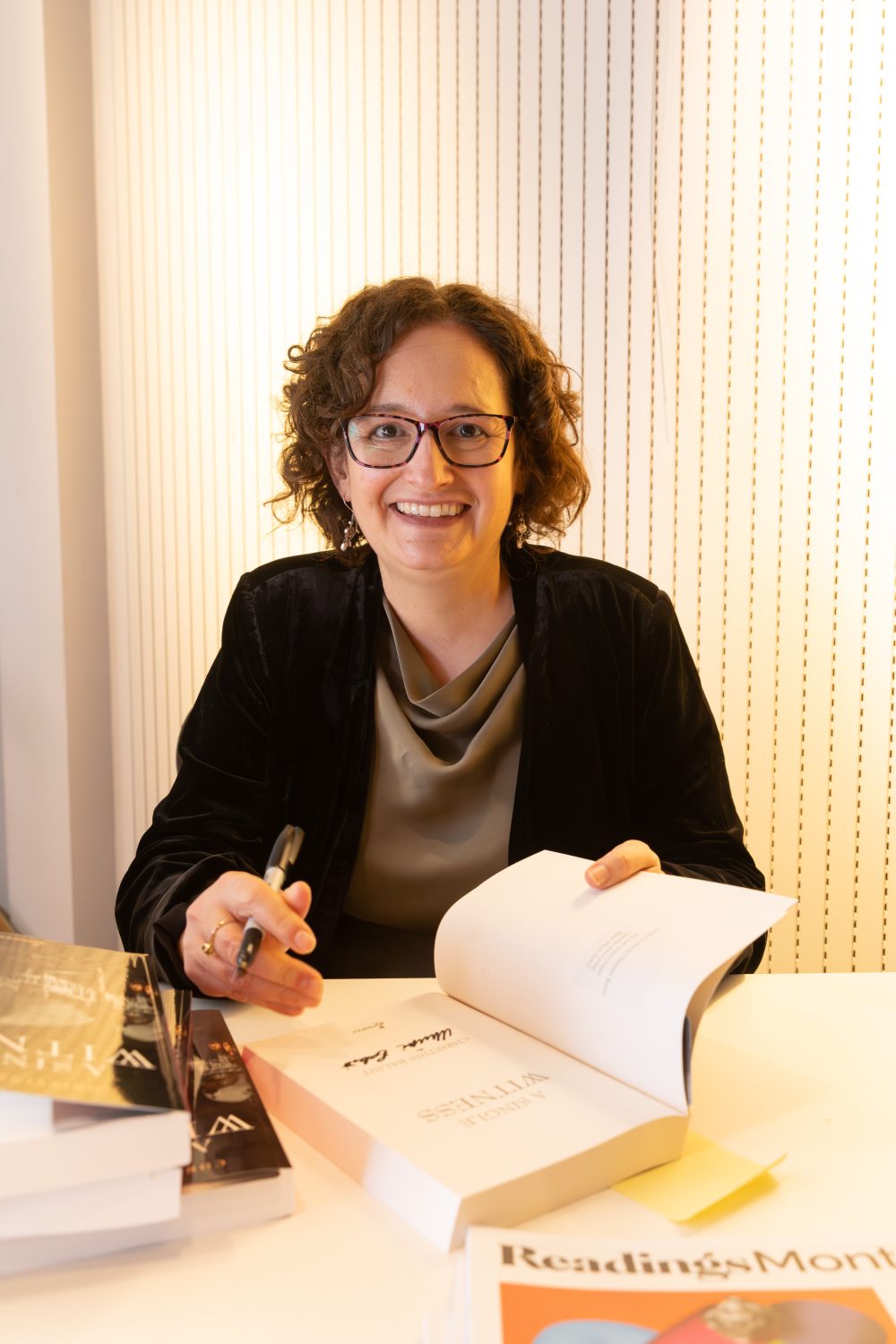
Christine Balint’s fourth historical novel, A Single Witness, captivates the reader from the very beginning to the final moments of the protagonist, Anna Maria Bonon’s heartbreaking true story. Anna Maria, a courageous thirteen-year-old, accuses her father, Giacomo Bonon, of rape, but is torn between her loyalty to her grandmother, Cattarina, and the local priest, Father Antonio, who both challenge her on these accusations. The novel explores how Anna Maria navigates the legal system in the mid-eighteenth century. A Single Witness is set in the mountain village of Piovene, in Vicenza, where she engages the Council of Ten to investigate her claims, and in Venice. The authenticity of Christine’s words creates a moving experience for the reader while exploring truth-telling. I met with Christine to discuss the research she was fortunate to do in Italy, including the process of bringing to life the devastating story of an innocent young girl.
The novel opens compellingly, taking the reader to a defining moment in Anna Maria’s journey. But this is not the only structural element that the reader notices. Flashbacks and events that may have led to what happened to Anna Maria are incorporated in the novel. Christine says, ‘When I read the court records, I realised that there were a couple of people behind the scenes whose behaviour was affecting what was going on.’ This includes Anna Maria’s Nonna, Cattarina, who Christine describes as a ‘conflicted character,’ because it was her son, Anna Maria’s father, who was inflicting horrific violence on the young girl. Christine explores the conflict she would have felt as a mother and as a grandmother. She also speaks about how Father Antonio changed his story in the two interviews during the investigation. Christine says, ‘[This was] quite fascinating to me, so I decided to have shifting points of view, and to incorporate the story of…Nonna, Catterina, and Father Antonio, alongside Anna Maria, because I felt they had influenced the outcome of the story.’ She adds, ‘But also…they tried to make it go away, and yet she didn’t, she remained defiant, and she was able to continue to speak out and get the outcome that she wanted.’ The narrative shines a light on Anna Maria’s strength alongside the darkness of trying to smother the truth.
This light and darkness in the novel seep from the pages. There is Anna Maria’s innocence, her mother’s spirit, and the character Barto Valdagno, who sheds some warmth on the protagonist’s story. Christine speaks about how this light and darkness began at the beginning of writing A Single Witness. She says, ‘There are so many steps involved with a complex historical novel, so when you begin, you haven’t done all the research yet.’ She adds, ‘But I think that the fact that Anna Maria managed to hold onto her courage and hope is a sign that it wasn’t all dark for her.’ Christine continues with how support must have existed in the village for her. ‘I don’t think she would have had the courage and self-belief to speak out if she’d been completely on her own.’ Therefore, ‘I did build in some other relationships for her…partly because I genuinely believe that she must have had those relationships.’ Furthermore, ‘We’re about creating an experience for the reader, and I wanted to make sure there was some light in there for the reader, and also, obviously, for me while I was working.’
Taking the conversation to the setting, as a reader myself, I felt that both the people and the place created a story and the story’s backdrop. Christine discusses how fortunate she is to conduct research in the very places where the novel is set. She says, ‘When I first arrived, I had a wonderful research assistant with me [called Barbara] who spoke Venetian, actually, who spoke dialect, which was invaluable in opening doors.’ Barbara successfully found a lead in the village, an architectural historian named Pino. ‘He had incredible knowledge of what the village layout would have been like three hundred years ago, and a lot of it was either still there, or very easy to imagine.’ Christine adds, ‘He showed me the mill where she would have worked, which is now a private house, [then] the church…I was able to go inside the priest’s house because that was where the archives were…It came to life very easily just because, in fact, a lot of places are still there.’
The hostile attitudes of the people in the neighbourhood toward Anna Maria’s father, and at times towards Anna Maria herself, are also evident in the narrative. The neighbours were all interviewed, and this highlighted one prosperous element of the court case, that the Council of Ten came from Venice to investigate Anna Maria’s father. Christine says, ‘There must have been several different scribes and interviewers, because it’s all different handwriting. The transcript from the court case is one hundred pages of handwriting…I’ve just paraphrased what they were saying.’ The interviews also showed Anna Maria spoke with her employer, and this is included in A Single Witness. She says, ‘I think other than that, people were guessing, and there were rumours spreading, but it was all there in the record, so I didn’t feel that I was making that up. I feel like that’s quite true to the attitudes that people actually had.’
Despite the challenges Anna Maria faced, she found her voice when dealing with the justice system. Christine says, ‘It was such an amazing thing that she had the courage to speak out…and I think that she was just absolutely terrified, and that was driving her. It was just a will to survive, and to build a better life for herself.’ On people’s attitudes, there was also the grandmother who saw the implications of Anna Maria’s accusations. Christine says, ‘In her heart, whether she believed or not…although I’ve played with that idea in the text, but I think her biggest fear was her kind of driver…[that is] what was going to happen to the family without a so-called breadwinner, and with such an enormous shame on the family.’ She adds, ‘At the same time, Anna Maria couldn’t see a way out without getting help from the justice system.’ Christine speaks on how, even with Father Antonio, victim-blaming toward Anna Maria was going on. ‘It’s kind of devastating how ineffectual he was.’ But in telling Anna Maria to yell so the neighbours could hear her, ‘I felt like that gave her the thought that other people might help her.’ She continues discussing how Anna Maria realised that what had happened to her was a real wrong, and that a justice system existed, and that she just had to find the right person to speak to.
According to the court records, Anna Maria met someone on a staircase in Vicenza during the trial, who perhaps also encouraged her to speak out. Christine says, ‘Anna Maria said “there was a man on the stairs who told me that if I didn’t speak out, I would be arrested because what I did with my father was wrong”, which is sort of heartbreaking, isn’t it [for] a young girl to hear that.’ She continues, ‘At the time, they said there was no man on the stairs, but when I got to the end of the research, I went and interviewed a historian at the University of Venice…[who thought] that wasn’t a ghost, that was a person.’ The historian was not sure, ‘but he said someone or someone in the village maybe had sent this man…to kind of frighten her into speaking out, because they wanted to get rid of her father from the village… and she was kind of the instrument for having him removed.’ This highlights just how frightened Anna Maria must have been.
Even before the horrific rapes happened to Anna Maria, a daughter who was severely betrayed by someone she trusted, the reader glimpses the trouble her father was causing in the village. A small excerpt taken from A Single Witness provides clues into her internal world:
“Silently, she begs her father not to give the neighbours anything more to complain about.”
Our discussion turned to Christine as a writer and what drives her as a teacher who has taught English and creative writing for many years. ‘I really love reading, I love writing, I love words, and I think there’s nothing better than kind of being able to make something out of words…make a story, make a poem, make a longer piece of work.’ The same writing exercise can be given to thirty students who then can create thirty ‘really different, unique pieces of work, so loosely connected.’ She adds, ‘It’s very inspiring, and it’s a huge privilege.’
Christine’s current writing project, titled The Last Music Keeper of Venice, incorporates a ‘dual timeline narrative…about female composers who existed but usually didn’t get to put their names on their work.’ She is working with the idea that perhaps famous composers did not actually compose all their work. She adds, ‘The other timeline is a young academic, [who] has the opportunity to go and do some research in Venice and uncovers some of this music…has been written by someone else.’ That is, women who had the education at the time to compose but could not put their name on their work. While we wait for Christine’s next historical book, A Single Witness is available for readers to experience Anna Maria’s character develop from a young teenager growing into a woman, a woman who carries a harsh history.
Christine Balint is the award-winning author of four novels including Water Music, which won the Viva la Novella Prize and The Salt Letters, shortlisted for the Vogels. Her work has been published to critical acclaim in Australia, the United States, Germany and Italy. She was deemed one of Barnes & Noble’s Great New Writers in 2001. Christine is a lecturer in English and Creative Writing at La Trobe University.