By Jena Woodhouse.
Above the deep-blue girdle of her groves
Moscow’s church-bells drizzle rainy notes.
Along Kaluga road the blind men rove—
A road steeped in Kaluga’s songs and ways,
Erasing and erasing all the names
Of pilgrims, who in darkness hymn God’s praise.
And I reflect: the time will come when I,
Grown weary of you, friends, and of you, foes,
And of the pliancy of Russian speech,
Upon my breast a silver crucifix,
Shall cross myself—and quietly set my feet
Upon the hallowed old Kaluga road.
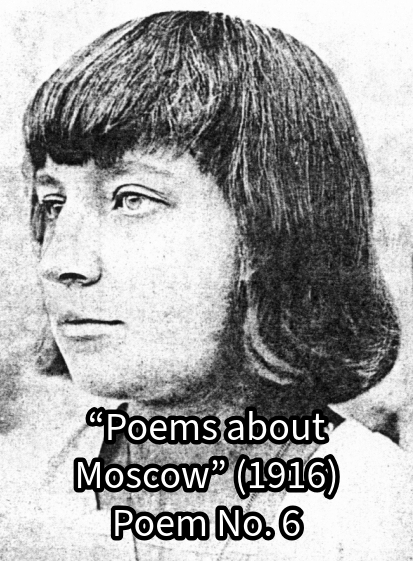
Trinity (day), 1916
*
Над синевою подмосковных рощ
Накрапывает колокольный дождь.
Бредут слепцы Калужскою дорогой—
Калужской—Песенной— привычной, и она
Смывает и смывает имена
Смиренных странников, во тьме поющих бога.
И думаю: когда-нибудь и я,
Устав от вас, враги, от вас, друзья,
И от уступчивости речи русской,
Надену крест серебряный на грудь,
Перекрещусь— и тихо тронусь в путь
По старой по дороге по Калужской.
Троицын день, 1916
Marina Tsvetaeva (1892-1941) is one of the most celebrated
Russian poets of the so-called Silver Age, her contemporaries
and associates including Pasternak, Akhmatova and Mandel’stam.
Surviving the years of the first world war and the revolutions of 1917,
she lost her youngest daughter to starvation, emigrating in 1922
to Prague then Paris. On her return to Soviet Russia in 1939,
a year when Stalinist repression of voices perceived as dissident
was intense, she was shunned by her fellow poets and subsequently
exiled, without any means of survival, to a remote outpost in the
Tartar Autonomous Republic, where she took her own life.